
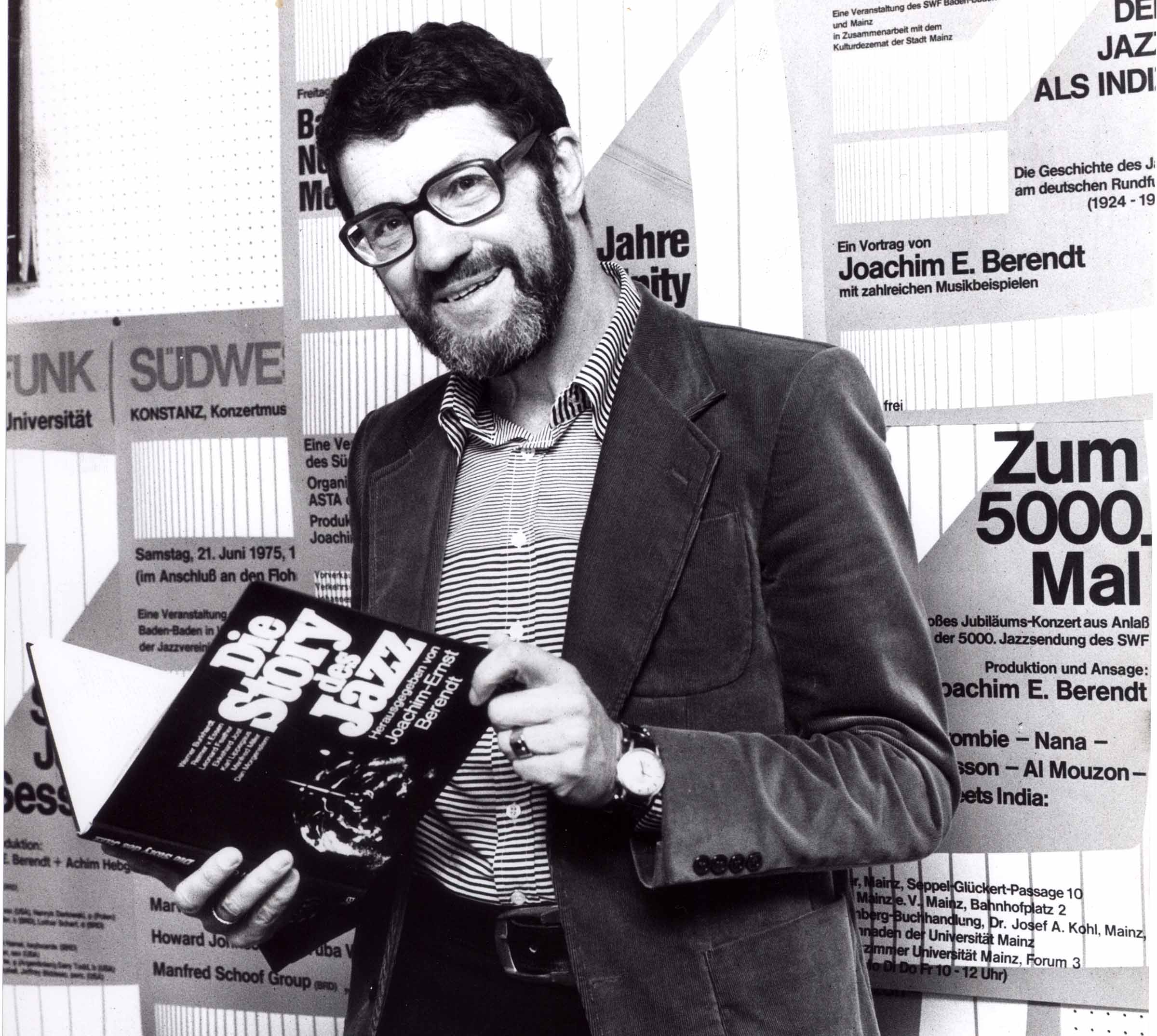
Joachim-Ernst Berendt - the son of a pastor who became a jazz pope (Photo ©MPS Archive)
„He who writes, stays“ is the saying in skat. This is also true when it comes to the history of the SABA/MPS studio and record label. The new 75-minute film „The legend lives on“ (here in the ARD media library) by Sascha Schmidt and Micha Bojanowski is available after „Jazzin‘ The Black Forest“ by Elke Baur is already the second documentary about the cult label from the Black Forest and shines through historical footage with Oscar Peterson, the MPS Studio or the Singers Unlimited. Toward the end, the entertaining documentary takes a melancholic turn: Marlies Brunner-Schwer (d. April 1, 2023) sits alone in the living room where the legendary house concerts once took place, reminiscing about those bygone days when her husband Hans-Georg Brunner-Schwer (HGBS) wrote jazz history.
One can begin to sense just how incredibly diverse and multifaceted the body of work released by the SABA/MPS record label has been over the years. After all, Brunner-Schwer released not only jazz, but also pop songs, so-called „sophisticated light music,“ and classical music. In addition, the label licensed productions from overseas, including those from “Prestige Records,” ranging from Miles Davis to Thelonious Monk. In total, we’re talking about well over 1,000 productions. Some of these records are highly sought after today, which is why these vinyl rarities are often available only at steep prices.

Were employed in the advertising department at MPS in the early 70s: Sitting Achim Frey, standing Dieter Hahne, visiting the MPS studio in September 2023 (Photo ©MPS-Studio e.V.)
In this film, however, the veil of oblivion shrouds those who played a key role at MPS/SABA. For example, Rolf Donner, the mere mention of which brings tears to the eyes of many former MPS employees. The fact that MPS will soon also stand for „The Most Perfect Sound“ was certainly due in large part to Donner, who had learned the ins and outs of sound engineering from the ground up. In the film, however, he isn’t mentioned at all.
The boss, on the other hand, Hans-Georg Brunner-Schwer, though he was said to have perfect pitch. He was certainly a highly ambitious audio enthusiast, a skilled technical tinker, and a great enabler with very high standards of quality. However, he had no formal training as a sound engineer. As a self-taught expert, he therefore relied on seasoned professionals such as Rolf Donner or Christa Gugeler instructed.
Furthermore, one gets the impression that even the music—on which the label has, for good reason, built its outstanding global reputation—is somewhat neglected in the documentary.

The Shure company advertised with Rolf Donner/MPS in the 1975 Funkschau (Archive Harald Greilich / MPS-Studio e.V.)
THE JAZZ POPE
It's a shame that Joachim-Ernst Berendt (JEB) is discussed in „MPS – The Legend Lives On“—without truly acknowledging his contributions. The bassist Eberhard Weber claims with a grin and in a classic Muckety-muck attitude: „Berendt was, after all, unmusical,“ and contradicts himself in the same sentence when he says, „Berendt knew exactly who played with whom, when, and in what key.“ Yet Joachim-Ernst Berendt He was anything but an unknown figure in the postwar music world, and his name practically jumps out at you when exploring MPS/SABA. Particularly fascinating is the ambivalent relationship between HGBS and JEB, which was likely shaped by vanity and a certain degree of alpha-male posturing. „Competition is good for business,“ as the saying goes—and that may well have been true here as well. In any case, it’s worth taking a closer look at the two very different biographies of these men, who, each in their own way, gave their all to jazz.
Like HGBS, the young Berendt had learned to play the piano in his youth. Later, he published numerous books on music, sound, and listening. He was certainly not unmusical. For MPS, he launched the „Jazz Meets the World“ series, thereby establishing the genre known as world music and repeatedly proving that he was far ahead of his time. At the same time, these recordings are among the central pillars on which the record label’s international reputation rests. Virtually all of the progressive and avant-garde productions on SABA/MPS were initiated by Berendt.
I made my first world music production in 1962 - a trio of Japanese koto players and the leading Japanese jazz ensemble at the time ... I tried something similar in Djakarta, Kuala Lumpur, Bombay, New Delphi, Tunisia, Africa and Brazil. A whole series of records was created...the first world music series ever.
(Joachim Ernst Berendt / Life is a sound)

Joachim Ernst Berendt with Nathan Davies 1965 in the MPS-Studio (Photo ©German Hasenfratz/MPS-Studio e.V.)
Berendt, born in Berlin in 1922, was a descendant of assimilated Jews. His mother left the family home when he was three years old, so he spent part of his childhood at a boarding school. His strict father Ernst Berendt He was a Protestant pastor and initially served in Berlin-Weißensee. Due to increasing problems and arrests by the Nazis, the family moved to Baden-Baden. Eventually, Ernst Berendt was sent to the Dachau concentration camp, where he was murdered. Joachim-Ernst Berendt visited his father at the concentration camp in 1942—a life-changing experience. Later, he was deployed to Russia, among other places, where he served in the Leningrad area. As a member of the class of 1922, he was among the few who survived their wartime service, since about one in three soldiers of that generation died.
After the war Joachim-Ernst Berendt the first employee of the Southwest radio. As a politically minded journalist, energetic festival organizer, writer, and producer—and above all as a staunch anti-fascist—he played a key role in introducing a generation of Germans to jazz after twelve years of military marches.
We were not only successful. We felt the resistance. Südwestfunk received letters of protest. One told me to be careful when I went home in the evening, otherwise „a few good German men's fists would teach me the right rhythm.“
What actually characterizes jazz - the personality of improvisation and phrasing, the play with different time levels in the phenomenon of swing, the renunciation of binding standards of tone formation - carries a message that cannot be misunderstood. It means tolerance, openness, freedom, individuality, self-responsibility. My sentence „Dictators don't swing“ made the rounds.
(Joachim Ernst Berendt / Life is a sound)

Books by Berendt (selection) © Archive MPS-Studio e.V.
He travelled the USA and found friends there, where jazz and blues have their roots, and he brought them to the stages of the festivals he organized. With John Coltrane and many other greats of the scene. Berendt is still held in high esteem in the jazz world today. His television series „Jazz heard and seen“ was groundbreaking. His „Jazz book“ is considered a standard work and has been translated into several languages.
...my plus was always the overview of all jazz - from ragtime to free. That was probably also what made my „jazz book“ the „textbook on jazz“ in the USA ... strangely enough, a book by a German about this most American of all arts, which for American sensibilities is the complete antithesis of the world status of „German music“.
(Joachim Ernst Berendt / Life is a sound)
Berendt, known for his outspoken views and also dubbed the „Pope of Jazz,“ founded the Berlin Jazz Days and the New Jazz Meeting Baden-Baden or organized the jazz section of the Donaueschingen Music Days. There, thanks to Berendt, the audience was treated to, among other things, a concert by Sun Ra. Now, take a guess—where was the recording of this concert later released?
As a musical free spirit, Berendt wasn’t always well-liked at MPS, but as a jack-of-all-trades, he was an absolute asset to Brunner-Schwer and his label. HGBS quickly recognized the sales potential of the productions Berendt initiated. Although Brunner-Schwer would sometimes deliberately avoid Berendt’s studio days—for example, by scheduling lengthy hair appointments in Zurich—the global contacts of the avant-garde sound artist HGBS enabled him to build an exceptionally broad repertoire for his label. However, there were some artists HGBS did not want to release on his label:
Peter Brötzmann („He’s not coming into my studio“), Herbie Hancock, Ornette Coleman or Wayne Shorter. Berendt has produced more than 130 recordings for SABA/MPS, as well as numerous liner notes.
It became clear relatively quickly that HGBS and Berendt had rather different musical interests. While HGBS devoted himself to old-school swing and, above all, piano recordings—with great recordings of Oscar Peterson, Bill Evans, Milt Buckner, Horst Jankowski or Monty Alexander –, Berendt was a modern jazz musician who drew inspiration from free jazz, psychedelic jazz, and world music and brought those influences to SABA/MPS. Many prominent pianists were recorded in the studio or in his home studio. It was the perfect mix for a label with such a broad scope as MPS.
What would MPS be without the productions initiated by Berendt featuring the Dave Pike Set, the „Jazz meets the World“-recordings, Archie Shepp, Baden Powell, Nathan Davis, Don Cherry, Cecil Taylor or the great Albert Mangelsdorff-LPs? With the Gunter Hampel Quintet With the album „Heartplants,“ Berendt produced one of the earliest European free-jazz records.
When you look at the many groundbreaking productions and liner notes that Berendt initiated and wrote for SABA/MPS, one can only regret that this man was given no more than 80 seconds in the current film. Berendt’s creative drive for jazz would actually be worth a documentary of its own.

Oscar Peterson, Willy Fruth and HGBS over a glass of beer in the Villa Brunner-Schwer (Photo ©MPS-Studio e.V.)
THE ENABLER
In stark contrast to JEB, HGBS was, even from a biographical perspective, a rather conservative man who was born in Villingen in 1927 as a descendant of the SABA founding family—literally „born with a silver spoon in his mouth.“ Founded as early as 1835 by Josef Benedikt Schwer in nearby Triberg, SABA was, alongside Kienzle, the largest industrial employer in the city of Zähringen and employed more than 3,500 people in the mid-1960s. The company had built its fortune on radios and, later, on television sets and refrigerators. The appliances „Made in the Black Forest“ enjoyed an excellent reputation for their quality, sound, and craftsmanship. It is said that Max Grundig was reportedly almost pathologically jealous of his Black Forest competitors.
But SABA’s glorious history also had its dark side: During the Nazi era, the company profited from arms contracts and manufactured the infamous „Volksempfänger“ radio. A forced-labor camp was located right on the company grounds. And as a family of great industrial importance, HGBS, his brother Hermann, and their mother also visited the “Führer” at Obersalzberg.

HGBS, Hitler and Hermann Brunner-Schwer on the Obersalzberg (from the out-of-print book „SABA - Bilanz einer Aufgabe“ by Hermann Brunner-Schwer)
The young Hans-Georg first heard jazz in 1944, during the war, while illegally eavesdropping on American bomber formations. The pilots were kept on course during their missions with jazz music broadcast over the radio. The 17-year-old HGBS picked up these signals and thus discovered, in an unusual way, „Moonlight Serenade“ by Glenn Miller. This experience had a profound impact on him.
After the war and the economic miracle, HGBS, together with his brother Hermann, was set to take over the management of SABA-Werke in 1961. Having already made his first recordings in the late 1950s, including with Hans Koller and Wolfgang Dauner, which he had recorded in his home studio, he founded the SABA Studio. After World War II and well into the 1950s, the Brunner-Schwer family temporarily lived in the premises on Richthofenstraße after their own villa had been confiscated by the French army. Just a few years later, they housed one of the most modern recording studios of its time.
When SABA was founded in 1968 by the American GTE Group HGBS operated independently of SABA and under the new name MPS (Musik Produktion Schwarzwald). With millions in his bank account and, as always, plenty of ambition and a passion for the perfect sound, he was able to pursue his passion: music productions, record releases, and licensing deals brought him recognition, attention, and created jobs. By the late 1960s, he had become one of Europe’s most prominent jazz producers.

Front left HGBS, 1999 at the press conference for the book release „Jazzin The Black Forest“ in the Neue Villinger Tonhalle (Photo: Andreas Rottmann/MPS-Studio e.V.)
JAZZIN‘ THE BLACK FOREST 1999
In 1999, during the production of the book „Jazzin‘ the Black Forest“, which I published, gave me the opportunity to have several phone conversations with Berendt. Since author Klaus-Gotthard Fischer had also devoted only a few sentences to Berendt, I arranged an interview with JEB for the book. I mailed him my list of questions, and his answers arrived quickly; he had even formulated and answered some questions of his own. We then fine-tuned some details over the phone. It almost seemed as if he had never received enough recognition and appreciation for his work during his lifetime.
He almost even came to Villingen for the book launch in June 1999. After all, we had Lee Konitz, Wolfgang Dauner and the Gunter Hampel Quartet with Alexander von Schlippenbach, Manfred Schoofand Pierre Courbois committed—all of them longtime companions of Berendt's. Mike Hennessey hosted the evening at the new Tonhalle. In addition to the concert, there was an exhibition featuring MPS album covers and objects such as the Sabamobile, while various DJs spun MPS rare groove jazz. The entire arts and culture press had announced their attendance.
HGBS was also in attendance and enjoyed this special evening to the fullest—after all, it was his life's work that was being celebrated here. The moment when… was particularly moving for him. Wolfgang Dauner played one of the first pieces he had recorded in the late 1950s at HGBS's home, when HGBS was still in his phase of technical experimentation.

HGBS signs „Jazzin The Black Forest“ for a former Saba employee in the Villingen Tonhalle (Photo: Andreas Rottmann/MPS-Studio e.V.)
At first, JEB flatly refused to come to the Black Forest for the presentation. He no longer wanted to have anything to do with MPS and had since turned his attention to other areas of interest.
I explained my point of view to him: The collaboration between HGBS and JEB had been important for MPS’s reputation—perhaps even a stroke of luck. After so many years, we could meet again over a glass of wine and some good music. At first, there was silence on the other end of the line. Then Berendt flipped through his calendar and seemed to gradually warm up to the idea. In the end, however, he had to decline—he already had a lecture in Stuttgart that evening.
In February 2000, just half a year after our last contact, Berendt was struck by a car on a street in Hamburg. He succumbed to his serious injuries shortly thereafter. Four years later, HGBS also died: He was struck by a car while crossing a crosswalk, right near his studio. Actually, another house concert had been in the works.
Goodbye, Hans-Georg Brunner-Schwer and Joachim-Ernst Berendt. And if there's a studio up there, you've surely already worked with them to achieve the „Most Perfect Sound“ Rolf Donner spoken.
Töni Schifer

Goodbye - Blurred, like the memories: HGBS and Wolfgang Dauner, 1999, book presentation Villingen (Photo © Andreas Rottmann/MPS-Studio e.V.)

MPS exhibition June 1999 organized by Crippled Dick Hot Wax! in the Villingen Tonhalle, book presentation „Jazzin‘ The Black Forest“ (Photo ©Andreas Rottmann / MPS-Studio e.V.)

Group picture with MPS cake: from left to right: Klaus Gotthard Fischer, Töni Schifer and Hans-Georg Brunner.-Schwer, 1999 Neue Tonhalle Villingen (Photo ©Andreas Rottmann / MPS-Studio e.V.)

Soundcheck with the Gunter Hampel Quintett, Neue Tonhalle Villingen, book presentation „Jazzin‘ The Black Forest“ 1999 (Photo ©Andreas Rottmann / MPS-Studio e.V.)